Category Archives: Employee Engagement
Navigating Startup Growth: Adapting Your Operating Model Every Year
If a startup’s journey can be likened to an expedition up Everest, then its operating model is the climbing gear—vital, adaptable, and often revised. In the early stages, founders rely on grit and flexibility. But as companies ascend and attempt to scale, they face a stark and simple truth: yesterday’s systems are rarely fit for tomorrow’s challenges. The premise of this memo is equally stark: your operating model must evolve—consciously and structurally—every 12 months if your company is to scale, thrive, and remain relevant.
This is not a speculative opinion. It is a necessity borne out by economic theory, pattern recognition, operational reality, and the statistical arc of business mortality. According to a 2023 McKinsey report, only 1 in 200 startups make it to $100M in revenue, and even fewer become sustainably profitable. The cliff isn’t due to product failure alone—it’s largely an operational failure to adapt at the right moment. Let’s explore why.
1. The Law of Exponential Complexity
Startups begin with a high signal-to-noise ratio. A few people, one product, and a common purpose. Communication is fluid, decision-making is swift, and adjustments are frequent. But as the team grows from 10 to 50 to 200, each node adds complexity. If you consider the formula for potential communication paths in a group—n(n-1)/2—you’ll find that at 10 employees, there are 45 unique interactions. At 50? That number explodes to 1,225.
This isn’t just theory. Each of those paths represents a potential decision delay, misalignment, or redundancy. Without an intentional redesign of how information flows, how priorities are set, and how accountability is structured, the weight of complexity crushes velocity. An operating model that worked flawlessly in Year 1 becomes a liability in Year 3.
Lesson: The operating model must evolve to actively simplify while the organization expands.
2. The 4 Seasons of Growth
Companies grow in phases, each requiring different operating assumptions. Think of them as seasons:
| Stage | Key Focus | Operating Model Needs |
|---|---|---|
| Start-up | Product-Market Fit | Agile, informal, founder-centric |
| Early Growth | Customer Traction | Lean teams, tight loops, scalable GTM |
| Scale-up | Repeatability | Functional specialization, metrics |
| Expansion | Market Leadership | Cross-functional governance, systems |
At each transition, the company must answer: What must we centralize vs. decentralize? What metrics now matter? Who owns what? A model that optimizes for speed in Year 1 may require guardrails in Year 2. And in Year 3, you may need hierarchy—yes, that dreaded word among startups—to maintain coherence.
Attempting to scale without rethinking the model is akin to flying a Cessna into a hurricane. Many try. Most crash.
3. From Hustle to System: Institutionalizing What Works
Founders often resist operating models because they evoke bureaucracy. But bureaucracy isn’t the issue—entropy is. As the organization grows, systems prevent chaos. A well-crafted operating model does three things:
- Defines governance – who decides what, when, and how.
- Aligns incentives – linking strategy, execution, and rewards.
- Enables measurement – providing real-time feedback on what matters.
Let’s take a practical example. In the early days, a product manager might report directly to the CEO and also collaborate closely with sales. But once you have multiple product lines and a sales org with regional P&Ls, that old model breaks. Now you need Product Ops. You need roadmap arbitration based on capacity planning, not charisma.
Translation: Institutionalize what worked ad hoc by architecting it into systems.
4. Why Every 12 Months? The Velocity Argument
Why not every 24 months? Or every 6? The 12-month cadence is grounded in several interlocking reasons:
- Business cycles: Most companies operate on annual planning rhythms. You set targets, budget resources, and align compensation yearly. The operating model must match that cadence or risk misalignment.
- Cultural absorption: People need time to digest one operating shift before another is introduced. Twelve months is the Goldilocks zone—enough to evaluate results but not too long to become obsolete.
- Market feedback: Every year brings fresh feedback from the market, investors, customers, and competitors. If your operating model doesn’t evolve in step, you’ll lose your edge—like a boxer refusing to switch stances mid-fight.
And then there’s compounding. Like interest on capital, small changes in systems—when made annually—compound dramatically. Optimize decision velocity by 10% annually, and in 5 years, you’ve doubled it. Delay, and you’re crushed by organizational debt.
5. The Operating Model Canvas
To guide this evolution, we recommend using a simplified Operating Model Canvas—a strategic tool that captures the six dimensions that must evolve together:
| Dimension | Key Questions |
|---|---|
| Structure | How are teams organized? What’s centralized? |
| Governance | Who decides what? What’s the escalation path? |
| Process | What are the key workflows? How do they scale? |
| People | Do roles align to strategy? How do we manage talent? |
| Technology | What systems support this stage? Where are the gaps? |
| Metrics | Are we measuring what matters now vs. before? |
Reviewing and recalibrating these dimensions annually ensures that the foundation evolves with the building. The alternative is often misalignment, where strategy runs ahead of execution—or worse, vice versa.
6. Case Studies in Motion: Lessons from the Trenches
a. Slack (Pre-acquisition)
In Year 1, Slack’s operating model emphasized velocity of product feedback. Engineers spoke to users directly, releases shipped weekly, and product decisions were founder-led. But by Year 3, with enterprise adoption rising, the model shifted: compliance, enterprise account teams, and customer success became core to the GTM motion. Without adjusting the operating model to support longer sales cycles and regulated customer needs, Slack could not have grown to a $1B+ revenue engine.
b. Airbnb
Initially, Airbnb’s operating rhythm centered on peer-to-peer UX. But as global regulatory scrutiny mounted, they created entirely new policy, legal, and trust & safety functions—none of which were needed in Year 1. Each year, Airbnb re-evaluated what capabilities were now “core” vs. “context.” That discipline allowed them to survive major downturns (like COVID) and rebound.
c. Stripe
Stripe invested heavily in internal tooling as they scaled. Recognizing that developer experience was not only for customers but also internal teams, they revised their internal operating platforms annually—often before they were broken. The result: a company that scaled to serve millions of businesses without succumbing to the chaos that often plagues hypergrowth.
7. The Cost of Inertia
Aging operating models extract a hidden tax. They confuse new hires, slow decisions, demoralize high performers, and inflate costs. Worse, they signal stagnation. In a landscape where capital efficiency is paramount (as underscored in post-2022 venture dynamics), bloated operating models are a death knell.
Consider this: According to Bessemer Venture Partners, top quartile SaaS companies show Rule of 40 compliance with fewer than 300 employees per $100M of ARR. Those that don’t? Often have twice the headcount with half the profitability—trapped in models that no longer fit their stage.
8. How to Operationalize the 12-Month Reset
For practical implementation, I suggest a 12-month Operating Model Review Cycle:
| Month | Focus Area |
|---|---|
| Jan | Strategic planning finalization |
| Feb | Gap analysis of current model |
| Mar | Cross-functional feedback loop |
| Apr | Draft new operating model vNext |
| May | Review with Exec Team |
| Jun | Pilot model changes |
| Jul | Refine and communicate broadly |
| Aug | Train managers on new structures |
| Sep | Integrate into budget planning |
| Oct | Lock model into FY plan |
| Nov | Run simulations/test governance |
| Dec | Prepare for January launch |
This cycle ensures that your org model does not lag behind your strategic ambition. It also sends a powerful cultural signal: we evolve intentionally, not reactively.
Conclusion: Be the Architect, Not the Archaeologist
Every successful company is, at some level, a systems company. Apple is as much about its supply chain as its design. Amazon is a masterclass in operating cadence. And Salesforce didn’t win by having a better CRM—it won by continuously evolving its go-to-market and operating structure.
To scale, you must be the architect of your company’s operating future—not an archaeologist digging up decisions made when the world was simpler.
So I leave you with this conviction: operating models are not carved in stone—they are coded in cycles. And the companies that win are those that rewrite that code every 12 months—with courage, with clarity, and with conviction.
Precision at Scale: How to Grow Without Drowning in Complexity
In business, as in life, scale is seductive. It promises more of the good things—revenue, reach, relevance. But it also invites something less welcome: complexity. And the thing about complexity is that it doesn’t ask for permission before showing up. It simply arrives, unannounced, and tends to stay longer than you’d like.
As we pursue scale, whether by growing teams, expanding into new markets, or launching adjacent product lines, we must ask a question that seems deceptively simple: how do we know we’re scaling the right way? That question is not just philosophical—it’s deeply economic. The right kind of scale brings leverage. The wrong kind brings entropy.

Now, if I’ve learned anything from years of allocating capital, it is this: returns come not just from growth, but from managing the cost and coordination required to sustain that growth. In fact, the most successful enterprises I’ve seen are not the ones that scaled fastest. They’re the ones that scaled precisely. So, let’s get into how one can scale thoughtfully, without overinvesting in capacity, and how to tell when the system you’ve built is either flourishing or faltering.
To begin, one must understand that scale and complexity do not rise in parallel; complexity has a nasty habit of accelerating. A company with two teams might have a handful of communication lines. Add a third team, and you don’t just add more conversations—you add relationships between every new and existing piece. In engineering terms, it’s a combinatorial explosion. In business terms, it’s meetings, misalignment, and missed expectations.
Cities provide a useful analogy. When they grow in population, certain efficiencies appear. Infrastructure per person often decreases, creating cost advantages. But cities also face nonlinear rises in crime, traffic, and disease—all manifestations of unmanaged complexity. The same is true in organizations. The system pays a tax for every additional node, whether that’s a service, a process, or a person. That tax is complexity, and it compounds.
Knowing this, we must invest in capacity like we would invest in capital markets—with restraint and foresight. Most failures in capacity planning stem from either a lack of preparation or an excess of confidence. The goal is to invest not when systems are already breaking, but just before the cracks form. And crucially, to invest no more than necessary to avoid those cracks.
Now, how do we avoid overshooting? I’ve found that the best approach is to treat capacity like runway. You want enough of it to support takeoff, but not so much that you’ve spent your fuel on unused pavement. We achieve this by investing in increments, triggered by observable thresholds. These thresholds should be quantitative and predictive—not merely anecdotal. If your servers are running at 85 percent utilization across sustained peak windows, that might justify additional infrastructure. If your engineering lead time starts rising despite team growth, it suggests friction has entered the system. Either way, what you’re watching for is not growth alone, but whether the system continues to behave elegantly under that growth.
Elegance matters. Systems that age well are modular, not monolithic. In software, this might mean microservices that scale independently. In operations, it might mean regional pods that carry their own load, instead of relying on a centralized command. Modular systems permit what I call “selective scaling”—adding capacity where needed, without inflating everything else. It’s like building a house where you can add another bedroom without having to reinforce the foundation. That kind of flexibility is worth gold.
Of course, any good decision needs a reliable forecast behind it. But forecasting is not about nailing the future to a decimal point. It is about bounding uncertainty. When evaluating whether to scale, I prefer forecasts that offer a range—base, best, and worst-case scenarios—and then tie investment decisions to the 75th percentile of demand. This ensures you’re covering plausible upside without betting on the moon.
Let’s not forget, however, that systems are only as good as the signals they emit. I’m wary of organizations that rely solely on lagging indicators like revenue or margin. These are important, but they are often the last to move. Leading indicators—cycle time, error rates, customer friction, engineer throughput—tell you much sooner whether your system is straining. In fact, I would argue that latency, broadly defined, is one of the clearest signs of stress. Latency in delivery. Latency in decisions. Latency in feedback. These are the early whispers before systems start to crack.
To measure whether we’re making good decisions, we need to ask not just if outcomes are improving, but if the effort to achieve them is becoming more predictable. Systems with high variability are harder to scale because they demand constant oversight. That’s a recipe for executive burnout and organizational drift. On the other hand, systems that produce consistent results with declining variance signal that the business is not just growing—it’s maturing.
Still, even the best forecasts and the finest metrics won’t help if you lack the discipline to say no. I’ve often told my teams that the most underrated skill in growth is the ability to stop. Stopping doesn’t mean failure; it means the wisdom to avoid doubling down when the signals aren’t there. This is where board oversight matters. Just as we wouldn’t pour more capital into an underperforming asset without a turn-around plan, we shouldn’t scale systems that aren’t showing clear returns.
So when do we stop? There are a few flags I look for. The first is what I call capacity waste—resources allocated but underused, like a datacenter running at 20 percent utilization, or a support team waiting for tickets that never come. That’s not readiness. That’s idle cost. The second flag is declining quality. If error rates, customer complaints, or rework spike following a scale-up, then your complexity is outpacing your coordination. Third, I pay attention to cognitive load. When decision-making becomes a game of email chains and meeting marathons, it’s time to question whether you’ve created a machine that’s too complicated to steer.
There’s also the budget creep test. If your capacity spending increases by more than 10 percent quarter over quarter without corresponding growth in throughput, you’re not scaling—you’re inflating. And in inflation, as in business, value gets diluted.
One way to guard against this is by treating architectural reserves like financial ones. You wouldn’t deploy your full cash reserve just because an opportunity looks interesting. You’d wait for evidence. Similarly, system buffers should be sized relative to forecast volatility, not organizational ambition. A modest buffer is prudent. An oversized one is expensive insurance.
Some companies fall into the trap of building for the market they hope to serve, not the one they actually have. They build as if the future were guaranteed. But the future rarely offers such certainty. A better strategy is to let the market pull capacity from you. When customers stretch your systems, then you invest. Not because it’s a bet, but because it’s a reaction to real demand.
There’s a final point worth making here. Scaling decisions are not one-time events. They are sequences of bets, each informed by updated evidence. You must remain agile enough to revise the plan. Quarterly evaluations, architectural reviews, and scenario testing are the boardroom equivalent of course correction. Just as pilots adjust mid-flight, companies must recalibrate as assumptions evolve.
To bring this down to earth, let me share a brief story. A fintech platform I advised once found itself growing at 80 percent quarter over quarter. Flush with success, they expanded their server infrastructure by 200 percent in a single quarter. For a while, it worked. But then something odd happened. Performance didn’t improve. Latency rose. Error rates jumped. Why? Because they hadn’t scaled the right parts. The orchestration layer, not the compute layer, was the bottleneck. Their added capacity actually increased system complexity without solving the real issue. It took a re-architecture, and six months of disciplined rework, to get things back on track. The lesson: scaling the wrong node is worse than not scaling at all.
In conclusion, scale is not the enemy. But ungoverned scale is. The real challenge is not growth, but precision. Knowing when to add, where to reinforce, and—perhaps most crucially—when to stop. If we build systems with care, monitor them with discipline, and remain intellectually honest about what’s working, we give ourselves the best chance to grow not just bigger, but better.
And that, to borrow a phrase from capital markets, is how you compound wisely.
Systems Thinking and Complexity Theory: Practical Tools for Complex Business Challenges
In business today, leaders are expected to make decisions faster and with better outcomes, often in environments filled with ambiguity and noise. The difference between companies that merely survive and those that thrive often comes down to the quality of thinking behind those decisions.
Two powerful tools that help elevate decision quality are systems thinking and complexity theory. These approaches are not academic exercises. They are practical ways to better understand the big picture, anticipate unintended consequences, and focus on what truly matters. They help leaders see connections across functions, understand how behavior evolves over time, and adapt more effectively when conditions change.
Let us first understand what each of these ideas means, and then look at how they can be applied to real business problems.
What is Systems Thinking?
Systems thinking is an approach that looks at a problem not in isolation but as part of a larger system of related factors. Rather than solving symptoms, it helps identify root causes. It focuses on how things interact over time, including feedback loops and time delays that may not be immediately obvious.
Imagine you are managing a business and notice that sales conversions are low. A traditional response might be to retrain the sales team or change the pitch deck. A systems thinker would ask broader questions. Are the leads being qualified properly? Has marketing changed its targeting criteria? Is pricing aligned with customer expectations? Are there delays in proposal generation? You begin to realize that what looks like a sales issue could be caused by something upstream in marketing or downstream in operations.
What is Complexity Theory?
Complexity theory applies when a system is made up of many agents or parts that interact and change over time. These parts adapt to one another, and the system as a whole evolves in unpredictable ways. In a complex system, outcomes are not linear. Small inputs can lead to large outcomes, and seemingly stable patterns can suddenly shift.
A good example is employee engagement. You might roll out a well-designed recognition program and expect morale to improve. But in practice, results may vary because employees interpret and respond differently based on team dynamics, trust in leadership, or recent changes in workload. Complexity theory helps leaders approach these systems with humility, awareness, and readiness to adjust based on feedback from the system itself.
Applying These Ideas to Real Business Challenges
Use Case 1: Sales Pipeline Bottleneck
A common challenge in many organizations is a slowdown or bottleneck in the sales pipeline. Traditional metrics may show that qualified leads are entering the top of the funnel, but deals are not progressing. Rather than focusing only on sales performance, a systems thinking approach would involve mapping the full sales cycle.
You might uncover that the product demo process is delayed because of engineering resource constraints. Or perhaps legal review for proposals is taking longer due to new compliance requirements. You may even discover that the leads being passed from marketing do not match the sales team’s target criteria, leading to wasted effort.
Using systems thinking, you start to see that the sales pipeline is not a simple sequence. It is an interconnected system involving marketing, sales, product, legal, and customer success. A change in one part affects the others. Once the feedback loops are visible, solutions become clearer and more effective. This might involve realigning handoff points, adjusting incentive structures, or investing in automation to speed up internal reviews.
In a more complex situation, complexity theory becomes useful. For example, if customer buying behavior has changed due to economic uncertainty, the usual pipeline patterns may no longer apply. You may need to test multiple strategies and watch for how the system responds, such as shortening the sales cycle for certain segments or offering pilot programs. You learn and adjust in real time, rather than assuming a static playbook will work.
Use Case 2: Increase in Voluntary Attrition
Voluntary attrition, especially among high performers, often triggers a reaction from HR to conduct exit interviews or offer retention bonuses. While these steps have some value, they often miss the deeper systemic causes.
A systems thinking approach would examine the broader employee experience. Are new hires receiving proper onboarding? Is workload increasing without changes in staffing? Are team leads trained in people management? Is career development aligned with employee expectations?
You might find that a recent reorganization led to unclear roles, increased stress, and a breakdown in peer collaboration. None of these factors alone might seem critical, but together they form a reinforcing loop that drives disengagement. Once identified, you can target specific leverage points, such as improving communication channels, resetting team norms, or introducing job rotation to restore a sense of progress and purpose.
Now layer in complexity theory. Culture, trust, and morale are not mechanical systems. They evolve based on stories people tell, leadership behavior, and informal networks. The same policy change can be embraced in one part of the organization and resisted in another. Solutions here often involve small interventions and feedback loops. You might launch listening sessions, try lightweight pulse surveys, or pilot flexible work models in select teams. You then monitor the ripple effects. The goal is not full control, but guided adaptation.
Separating Signal from Noise
In both examples above, systems thinking and complexity theory help leaders rise above the noise. Not every metric, complaint, or fluctuation requires action. But when seen in context, some of these patterns reveal early signals of deeper shifts.
The strength of these frameworks is that they encourage patience, curiosity, and structured exploration. You avoid knee-jerk reactions and instead look for root causes and emerging trends. Over time, this leads to better diagnosis, better prioritization, and better outcomes.
Final Thoughts
In a world where data is abundant but insight is rare, systems thinking and complexity theory provide a critical edge. They help organizations become more aware, more adaptive, and more resilient.
Whether you are trying to improve operational efficiency, respond to market changes, or build a healthier culture, these approaches offer practical tools to move from reactive problem-solving to thoughtful system design.
You do not need to be a specialist to apply these principles. You just need to be willing to ask broader questions, look for patterns, and stay open to learning from the system you are trying to improve.
This kind of thinking is not just smart. It is becoming essential for long-term business success.
A Journey among numbers and beyond
The last couple of years have been a fruitful journey. I have waded into the world of data analytics and appreciate the new perspectives that has opened up along the way. For the longest time, I have dabbled in finance and accounting, and I have thoroughly enjoyed the technical aspects of those fields. And then the courses that I have taken at Georgia Tech has given me a deeper appreciation of data and data patterns. Surfacing relationships which I perhaps would not have seen, drawing inferences that are counter-intuitive to impulsive thinking, and establishing a personal nomenclature in decision theory have allowed me to establish compelling narratives and draw emerging patterns on what would originally be the dry and the mundane.
Scale by Geoffrey West propelled me into the world of complexity theory. So much so that I have finished half a book on a field that I knew nothing about: yet, I found that field fascinating which led me to study the vast literature in Complexity Theory and the historical evolution of systems thinking. I have pledged that once my data analytics program is done with, I will immediately pursue a deeper dive into systems engineering. This leads me to additional discoveries of myself and the amazing world that we live in. Let me explain further:

I was trained as an economist at college. I had an interest in Neo-classical economics and the Austrian school of economics, in particular! Under the guidance of some amazing professors ( Dr. Kurt Leube, Dr. Shyam Kamath, and Dr. Stephen Shmanske), I jumped into economic philosophy with wild abandon. That led me to spend oodles of time reading Menger, Hayek, Mises, Kirzner, Bohm-Bawerk, Keynes, Friedman, Amartya Sen and Herbert Simon. I wish I would have read more, but the list was long and the time was short. Alas, I graduated! And when I secured a Masters in Finance, I took a tangential interest in accounting and all of a sudden: I fell in love with accounting theory and practice. It is often said that economists and accountants do not make good bed fellows, but I might be a notable exception to the rule. I approached accounting with the scalpel of economic analysis, and then the world of GAAP and IFRS became very clear. So once again, I wanted to go deep in accounting and finance and thereby received my graduate degree in both fields. And then years and years of work in many different environments that provided active material to supplement my studies.

The work spanned almost three decades since, and I rarely broached the rarified air of academics. Through those years, I became an avid book collector and reignited my interest in literature, history and philosophy. In addition, I had this interest in world cinema, and every couple of years I would immerse myself in watching the films of Elia Kazan, Coppola, Godard, Wilder, Ray, Ford, Kurosawa, Bergman, Ghatak, Scorcese, Fassbinder, Bunuel, Hitchcock, Eisenstein, Chaplin … the list goes on and on and on!

And while at that, I took time to follow my father’s counsel and studied the masters: Russian, English and French novelists, Bellow, Singer, Mann, Marquez, Rushdie, Solzhenitsyn, Mahfouz, Havel, Calvino, Cervantes, Baldwin, Rolland, Voltaire … and between world cinema and world literature – I collected books and felt like these were my strawberry fields – forever! I tried my hand publishing a book of poetry and then crafted an entire novel of a family in India: from 1792 through 2004 which led to my interest in history: started off with my interest in the history of Bengal and Chittagong before it expanded through strands to encompass the history of the world. But these were routine and aimless wanderings in the garden of delights: late into the nights and far from the madding crowd. But work continued: and it took me, a Bombayite from Calcutta, to faraway places where I perhaps would never have dreamt of being : London, Paris, Copenhagen, Dublin, Colombo, Vancouver, New York, Chicago, Warsaw, and many other less famous places. Travel provides a further elasticity of mind I think : it places you in territories without maps and then you are left to wander again: I frequented cafes, the bazaars, the street eateries, the museums, the pubs, the bookstores and the libraries. It dawns upon you then: everything is connected – somehow the world conspires to reveal those connections if you open your eyes wide enough. That was the other me – another self that was not rooted, except upon the common ground of humanity. I needed a constant in my life: work provided that constancy.


Here I am: thirty years or so and I am realizing that the duality of my self is merging rapidly. I think it is what Goethe would call the gestalt awakening: the realization that everything distant and discrete is part of a unified whole. Data analytics validated that since it brought together discrete worlds by the means of mathematics and statistical awakening. And yet there is this deep and bigger feeling : there is more to know and I am running out of time. My days are getting longer, my reading list is getting longer, and sometimes I feel that I am trying to pack matter into this white dwarf of my brain and weaving my cosmology of mind. It is a remarkable feeling to start seeing the world as a montage of images — and together it makes a lot of sense.
When I read of some of the classic thinkers of early ages – those who have walked the corridors of Oxford and Cambridge in particular – the Dominican friars, the ratnas in Indian courts, the irreverent thinkers and the Isadora Duncans – I am amazed at their accomplishments and wide interests in vast intellectual territories: how could one so young cover so much and then hammer out some of the greatest treatises that serve as timeless colonnades in boulevards of thought. It seemed so impossible and I might attribute this to the fact that there were perhaps less distractions then – more introspection that led one to articulate their thoughts. What world would produce a Ben Franklin and a Bacon, Shakespeare and Aristotle, Proust and Montaigne, Voltaire and Cervantes! It is amazing to reflect back upon these masters and just wonder: WOW!
I live in a world today where the benefits of cheap and free education is widely available: I live in a world where it is easy for me to communicate with scholars at the Santa Fe Institute: I live in a world where I can now rake my interest in natural sciences to put everything together: I live in a world where I have access to great lectures in great halls: I live in a world where I can hop into my car and head off to Berkeley to meet old friends and have a good laugh: I live in a world which is crazy amazing. I might even have the Panglossian streak: we live in the best of all possible worlds and it will only get better.

But it matters now more than ever to create that framework: and that is what I was referring to earlier, namely: my interest in system engineering. It is less about engineering – I do not know much about it and I am less sure that I want be one, but what I do know is that it proffers a framework that creates the boundaries such that all the points of light come together is a scintillating hue. How do we find order in chaos? What is the mind-body problem? How do the puzzles of yesteryears get solved in the light of the interdisciplinary or multidisciplinary approach in our world today. I worked as a CFO at Singularity, and had the pleasure of engaging with brilliant minds like Peter Diamandis and Ray Kurzweil: they spoke in abundance about the abundance of the world and the arrival of Singularity – but I look upon singularity differently now – it is the ocean where all the tributaries of distant subjects come together – and with the churning of the ocean – new paradigms, new discoveries, new literature, new expression and new humanity emerge. In 1946, Capra directed : It is a Wonderful Life. 75 years later and it is only getting better! It is a Marvelous Life.

Complexity: An Introduction
The past was so simple. Life was so simple and good. Those were the good old days. How often have you heard these ruminations? It is fairly common! Surprisingly, as we forge a path into the future, these ruminations gather pace. We become nostalgic and we thus rake fear of the future. We attribute a good life to a simple life. But the simple life is measured against the past. In fact, our modus operandi is to chunk up the past into timeboxes and then surface all the positive elements. While that is an endeavor that might give us some respite from what is happening today, the fact is that the nostalgia is largely grounded in fiction. It would be foolish to recall the best elements and compare it to what we see emerging today which conflates good and bad. We are wired for survival: If we have survived into the present, it makes for a good argument perhaps that the conditions that led to our survival today can only be due to a constellation of good factors that far outweighed the bad. But when we look into the future rife with uncertainty, we create this rather dystopian world – a world of gloom and doom and then we wonder: why are we so stressed? Soon we engage in a vicious cycle of thought and our actions are governed by the thought. You have heard – Hope for the best and plan for the worst. Really? I would imagine that when one hopes for the best and the facts do not undermine the trend, would it not be better to hope for the best and plan for the best. It is true that things might not work out as planned but ought we to always build out models and frameworks to counter that possibility. We say that the world is complex and that the complexity forces us to establish certain heuristics to navigate the plenar forces of complexity. So let us understand what complexity is. What does it mean? And with our new understanding of complexity through the course of this chapter, would we perhaps arrive at a different mindset that speaks of optimism and innovation. We will certainly not settle that matter at the end of this chapter, but we hope that we will surface enough questions, so you can reflect upon where we are and where we are going in a more judicious manner – a manner grounded on facts and values. Let us now begin our journey!

The sky is blue. We hear this statement. It is a simple statement. There is a noun, a verb and an adjective. In the English-speaking world, we can only agree on what constitutes the “sky”. We might have a hard time defining it – Merriam Webster defines the sky as the upper atmosphere or expanse of space that constitutes an apparent great vault or arch over the earth. A five-year-old would point to the sky to define sky. Now how do we define blue. A primary color between green and violet. Is that how you think about blue or do you just arrive at an understanding of what that color means. Once again, a five-year-old would identify blue: she would not look at green and violet as constituent colors. The statement – The sky is blue – for the sake of argument is fairly simple!
However, if we say that the sky is a shade of blue, we introduce an element of ambiguity, don’t we? Is it dark blue, light blue, sky blue (so we get into recursive thinking), or some other property that is bluish but not quite blue. What has emerged thus is an element of complexity – a new variable that might be considered a slider on a scale. How we slide our understanding is determined by our experience, our perception or even our wishful thinking. The point being that complexity ceases to be purely an objective property. Rather it is an emergent property driven by our interpretation. Protagoras, an ancient Greek philosopher, says that the man is a measure of all things. What he is saying is that our lens of evaluation is purely predicated on our experiences in life. There is nothing that exists outside the boundaries of our experience. Now Socrates arrived at a different view – namely, he proved that certain elements are ordered in a manner that exists outside the boundaries of our experience. We will get back to this in later chapters. The point being that complexity is an emergent phenomenon that occurs due to our interpretation. Natural scientists will argue, like Socrates, that there are complex systems that exist despite our interpretations. And that is true as well. So how do we balance these opposing views at the same time: is that a sign of insanity? Well, that is a very complex question (excuse my pun) and so we need to further expand on the term Complexity.
In order to define complexity, let us now break this up a bit further. Complex systems have multiple variables: these variables interact with each other; these variables might be subject to interpretation in the human condition; if not, these variables interact in a manner to enable emergent properties which might have a life of its own. These complex systems might be decentralized and have information processing pathways outside the lens of science and human perception. The complex systems are malleable and adaptive.
Markets are complex institution. When we try to centralize the market, then we take a position that we feel we understand the complexity and thus can determine the outcomes in a certain way. Socialist governments have long tried to manage markets but have not been successful. Nobel winner, Frederich Hayek, has long argued that the markets are a result of spontaneous order and not design. It has multiple variables, significant information processing is underway at any given time in an active market, and the market adapts to the information processing mechanism. But there are winners and losers in a market as well. Why? Because each of them observes the market dynamics and arrive at different conclusions. Complexity does not follow a deterministic path. Neither does the market and we have lot of success and failures that suggest that to be the case.

Let us look at another example. Examples will probably give us an appreciation for the concept and this will be very important as we sped through the journey into the future.
Insect behavior is a case in point. Whether we look at bees or ants, it is a common fact that these insects have extremely complex systems despite the lack of sufficient instruments for survival for one bee or one ant. In 1705, Bernard Mandeville wrote a book called: Fable of the Bees. It was a poem. Here is a part of the poem. What Mandeville is clearly hinting at is the fact that there would be an innate failure to centralize complex systems like a bee hive. Rather, the complex systems emerge in a way to create innate systems that stabilize for success and survival in the long run.
A Spacious Hive well stock’d with Bees,
That lived in Luxury and Ease;
And yet as fam’d for Laws and Arms,
As yielding large and early Swarms;
Was counted the great Nursery
Of Sciences and Industry.
No Bees had better Government,
More Fickleness, or less Content.
They were not Slaves to Tyranny,
Nor ruled by wild Democracy;
But Kings, that could not wrong, because
Their Power was circumscrib’d by Laws.
Then we have the ant colonies. An ant is blind. Yet a colony has collective intelligence. The ants work together, despite individual shortcomings that challenge an individual survival, to figure out how to exist and propagate as group. How does a simple living organism that is subject to the whims and fancies of nature survive and seed every corner of the earth in great volumes? Entomologists and social scientists and biologists have tried to figure this out and have posited a lot of theories. The point is that complex systems are not bounded by our reason alone. The whole is greater than the sum of the parts.
Key Takeaway
A complex system is the result of the interaction of a network of variables that gives rise to collective behavior, information processing and self-learning and adaptive system that does not completely lie in the purview of human explanation.
Books to Read – 2017
It has been a while since I posted on this blog. It just so happens that life is what happens to you when you have other plans. Having said that, I decided early this year to ready 42 books this year across a wide range of genres. I have been trying to keep pace, and have succeeded so far.
Here are the books that I have read and plan to read:
- Song of Solomon by Toni Morrison ( Read)
- The Better Angels of Our Nature by Steven Pinker ( Read)
- Black Dogs by Ian McEwan ( Read)
- Nutshell: A Novel by Ian McEwan ( Read)
- Dr. Jekyl and Mr. Hyde by Robert Louis Stevenson ( Read)
- Moby Dick by Herman Melville
- The Plot Against America by Phil Roth
- Humboldt’s Gift by Saul Bellow
- The Innovators by Walter Isaacson
- Sapiens: A Brief History of Mankind by Yuval Harari
- The House of Morgan by Ron Chernow
- American Political Rhetoric: Essential Speeches and Writings by Peter Augustine Lawler and Robert Schaefer
- Keynes Hayek: The Clash that defined Modern Economics by Nicholas Wapshott
- The Year of Magical Thinking by Joan Didion
- Small Great Things by Jodi Picoult
- The Conscience of a Liberal by Paul Krugman
- Globalization and its Discontents by Joseph Stiglitz
- Twilight of the Elites: America after Meritocracy by Chris Hayes
- What is Mathematics: An Elementary Approach to Idea and Methods by Robbins & Stewart
- Algorithms to live by: Computer Science of Human Decisions by Christian & Griffiths
- Andrew Carnegie by David Nasaw
- Just Mercy: A Story of Justice and Redemption by Bryan Stevenson
- The Evolution of Everything: How New Ideas Emerge by Matt Ridley
- The Only Game in Town: Central Banks, Instability and Avoiding the Next Collapse by Mohammed El-Arian
- The Relentless Revolution: A History of Capitalism by Joyce Appleby
- The Industries of the Future by Alec Ross
- Where Good Ideas come from by Steven Johnson
- Original: How Non-Conformists move the world by Adam Grant
- Start with Why by Simon Sinek
- The Discreet Hero by Mario Vargas Llosa
- Istanbul by Orhan Pamuk
- Jefferson and Hamilton: The Rivalry that Forged a Nation by John Ferling
- The Orphan Master’s Son: A Novel by Adam Johnson
- Between the World and Me: Ta Nehisi-Coates
- Active Liberty: Interpreting our Democratic Constitution
- The Blue Guitar by John Banville
- The Euro Crisis and its Aftermath by Jean Pisani-Fery
- Africa: Why Economists get it wrong by Morten Jerven
- The Snowball: Warren Buffett and the Business of Life
- To Explain the World: The Discovery of Modern Science by Steven Weinberg
- The Meursalt Investigation by Daoud and Cullen
- The Stranger by Albert Camus
Disseminating financial knowledge to develop engaged organizations
Financial awareness of key drivers are becoming the paramount leading indicators for organizational success. For most, the finance department is a corner office service that offers ad hoc analysis on strategic and operational initiatives to a company, and provides an ex-post assessment of the financial condition of the company among a select few. There are some key financial metrics that one wants to measure across all companies and all industries without exception, but then there are unique metrics that reflect the key underlying drivers for organizational success. Organizations align their forays into new markets, new strategies and new ventures around a narrative that culminates in a financial metric or a proxy that illustrates opportunities lost or gained.
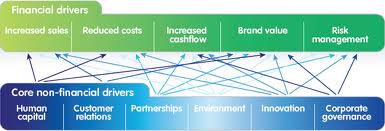
Having been cast in operational finance roles for a good length of my career, I have often encountered a high level of interest to learn financial concepts in areas such as engineering, product management, operations, sales, etc. I have to admit that I have been humbled by the fairly wide common-sense understanding of basic financial concepts that these folks have. However, in most cases, the understanding is less than skin deep with misunderstandings that are meaningful. The good news is that I have also noticed a promising trend, namely … the questions are more thoroughly weighed by the “non-finance” participants, and there seems to be an elevated understanding of key financial drivers that translate to commercial success. This knowledge continues to accelerate … largely, because of convergence of areas around data science, analytics, assessment of personal ownership stakes, etc. But the passing of such information across these channels to the hungry recipients are not formalized. In other words, I posit that having a formal channel of inculcating financial education across the various functional areas would pay rich dividends for the company in the long run. Finance is a vast enough field that partaking general knowledge in these concepts which are more than merely skin-deep would also enable the finance group to engage in meaningful conversations with other functional experts, thus allowing the narrative around the numbers to be more wholesome. Thus, imparting the financial knowledge would be beneficial to the finance department as well.

To be effective in creating a formal channel of disseminating information of the key areas in finance that matter to the organization, it is important to understand the operational drivers. When I say operational drivers, I am expanding that to encompass drivers that may uniquely affect other functional areas. For example, sales may be concerned with revenue, margins whereas production may be concerned with server capacity, work-in-process and throughput, etc. At the end, the financial metrics are derivatives. They are cross products of single or multiple drivers and these are the elements that need to be fleshed out to effect a spirited conversation. That would then enable the production of a financial barometer that everyone in the organization can rally behind and understand, and more importantly … be able to assess how their individual contribution has and will advance organization goals.
Introduce Culture into Product Development
All products go through a life-cycle. However, the genius of an organization lies in how to manage the life-cycle of the product and extend it as necessary to serve the customers. Thus, it is not merely the wizardry in technology and manufacturing that determine the ultimate longevity of the product in the market and the mind share of the customer. The product has to respond to the diversity of demands determined by disposable income, demographics, geography, etc. In business school speak, we say that this is part of market segmentation coupled with the appropriate marketing message. However, there is not an explicit strategy formulated around identifying
- Corporate Culture
- Extended Culture
To achieve success, firms increasingly must develop products by leveraging ad coordinating broad creative capabilities and resources, which often are diffused across geographical and cultural boundaries. But what we have to explore is a lot more than that from the incipient stages that a product has imagined: How do we instill unique corporate DNA into the product that immediately marks the product with a corporate signature? In addition, how do we built out a product that is tenable across the farthest reaches of geography and cultural diversity?

Thus, an innovative approach is called for in product development … particularly, in a global context. The approach entails getting cross-disciplinary teams in liberal arts, science, business, etc. to work together to gather deeper insights into the cultural strains that drive decisions in various markets. To reiterate, there is no one particular function that is paramount: all of them have to work and improvise together while ensuring that there are channels that gather feedback. The cross disciplinary team and the institutionalization of a feedback mechanism that can be quickly acted upon are the key parameters to ensure that the right product is in the market and that it will be extended accordingly to the chatter of the crowds.
Having said that, this is hardly news! A lot of companies are well on their way to instill these factors into product design and development. Companies have created organizational architectures in the corporate structure in a manner that culturally appropriate products are developed and maintained in dispersed local markets. However, in most instances, we have also seen that the way they view this is to have local managers run the show, with the presumption that these “culturally appropriate” products will make good in those markets. But along the way, the piece that dissembles over time on account of creating the local flavor is that the product may not mirror the culture that the corporate group wants to instill. If these two are not aptly managed and balanced, islands of conflict will be created. Thus, my contention is that a top-down value mandate ought to set the appropriate parameters inside which the hotbed of collaborative activity would take place for product design and development in various markets.

Thus the necessary top down value systems that would bring culture into products would be:
- Open areas for employees to express their thoughts and ideas
- Diversity of people with different skill sets in product teams will contribute to product development
- Encouraging internal and external speakers to expound upon the product touch points in the community.
- Empowerment and recognition systems.
- Proper formulation of monetary incentives to inspire and maintain focus.
LinkedIn Endorsements: A Failure or a Brilliant Strategy?
LinkedIn endorsements have no value. So says many pundits! Here are some interesting articles that speaks of the uselessness of this product feature in LinkedIn.
http://www.businessinsider.com/linkedin-drops-endorsements-by-year-end-2013-3
http://mashable.com/2013/01/03/linkedins-endorsements-meaningless/
I have some opinions on this matter. I started a company last year that allows people within and outside of the company to recommend professionals based on projects. We have been ushered into a world where our jobs, for the most part, constitute a series of projects that are undertaken over the course of a person’s career. The recognition system around this granular element is lacking; we have recommendations and recognition systems that have been popularized by LinkedIn, Kudos, Rypple, etc. But we have not seen much development in tools that address recognition around projects in the public domain. I foresee the possibility of LinkedIn getting into this space soon. Why? It is simple. The answer is in their “useless” Endorsement feature that has been on since late last year. As of March 13, one billion endorsements have been given to 56 million LinkedIn members, an average of about 4 per person. What does this mean? It means that LinkedIn has just validated a potential feature which will add more flavor to the endorsements – Why have you granted these endorsements in the first place?
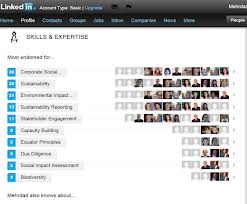
Thus, it stands to reason the natural step is to reach out to these endorsers by providing them appropriate templates to add more flavor to the endorsements. Doing so will force a small community of the 56 million participants to add some flavor. Even if that constitutes 10%, that is almost 5.6M members who are contributing to this feature. Now how many products do you know that release one feature and very quickly gather close to six million active participants to use it? In addition, this would only gain force since more and more people would use this feature and all of a sudden … the endorsements become a beachhead into a very strategic product.

The other area that LinkedIn will probably step into is to catch the users young. Today it happens to be professionals; I will not be surprised if they start moving into the university/college space and what is a more effective way to bridge than to position a product that recognizes individuals against projects the individuals have collaborated on.

LinkedIn and Facebook are two of the great companies of our time and they are peopled with incredibly smart people. So what may seemingly appear as a great failure in fact will become the enabler of a successful product that will significantly increase the revenue streams of LinkedIn in the long run!
Darkness at Noon in Facebook!
Facebook began with a simple thesis: Connect Friends. That was the sine qua non of its existence. From a simple thesis to an effective UI design, Facebook has grown over the years to become the third largest community in the world. But as of the last few years they have had to resort to generating revenue to meet shareholder expectations. Today it is noon at Facebook but there is the long shadow of darkness that I posit have fallen upon perhaps one of the most influential companies in history.

The fact is that leaping from connecting friends to managing the conversations allows Facebook to create this petri dish to understand social interactions at large scale eased by their fine technology platform. To that end, they are moving into alternative distribution channels to create broader reach into global audience and to gather deeper insights into the interaction templates of the participants. The possibilities are immense: in that, this platform can be a collaborative beachhead into discoveries, exploration, learning, education, social and environmental awareness and ultimately contribute to elevated human conscience. But it has faltered, perhaps the shareholders and the analysts are much to blame, on account of the fangled existence of market demands and it has become one global billboard for advertisers to promote their brands. Darkness at noon is the most appropriate metaphor to reflect Facebook as it is now.

Let us take a small turn to briefly look at some of other very influential companies that have not been as much derailed as has Facebook. The companies are Twitter, Google and LinkedIn. Each of them are the leaders in their category, and all of them have moved toward monetization schemes from their specific user base. Each of them has weighed in significantly in their respective categories to create movements that have or will affect the course of the future. We all know how Twitter has contributed to super-fast news feeds globally that have spontaneously generated mass coalescence around issues that make a difference; Google has been an effective tool to allow an average person to access information; and LinkedIn has created professional and collaborative environment in the professional space. Thus, all three of these companies, despite supplementing fully their appetite for revenue through advertising, have not compromised their quintessence for being. Now all of these companies can definitely move their artillery to encompass the trajectory of FB but that would be a steep hill to climb. Furthermore, these companies have an aura associated within their categories: attempts to move out of their category have been feeble at best, and in some instances, not successful. Facebook has a phenomenal chance of putting together what they have to create a communion of knowledge and wisdom. And no company exists in the market better suited to do that at this point.

One could counter that Facebook sticks to its original vision and that what we have today is indeed what Facebook had planned for all along since the beginning. I don’t disagree. My point of contention in this matter is that though is that Facebook has created this informal and awesome platform for conversations and communities among friends, it has glossed over the immense positive fallout that could occur as a result of these interactions. And that is the development and enhancement of knowledge, collaboration, cultural play, encourage a diversity of thought, philanthropy, crowd sourcing scientific and artistic breakthroughs, etc. In other words, the objective has been met for the most part. Thank you Mark! Now Facebook needs to usher in a renaissance in the courtyard. Facebook needs to find a way out of the advertising morass that has shed darkness over all the product extensions and launches that have taken place over the last 2 years: Facebook can force a point of inflection to quadruple its impact on the course of history and knowledge. And the revenue will follow!

 Linked Stars Blog