Category Archives: Learning Organization
Why Jugglestars? How will this benefit you?
Consider this. Your professional career is a series of projects. Employers look for accountability and performance, and they measure you by how you fare on your projects. Everything else, for the most part, is white noise. The projects you work on establish your skill set and before long – your career trajectory. However, all the great stuff that you have done at work is for the most part hidden from other people in your company or your professional colleagues. You may get a recommendation on LinkedIn, which is fairly high-level, or you may receive endorsements for your skills, which is awesome. But the Endorsements on LinkedIn seem a little random, don’t they? Wouldn’t it be just awesome to recognize, or be recognized by, your colleagues for projects that you have worked on. We are sure that there are projects that you have worked on that involves third-party vendors, consultants, service providers, clients, etc. – well, now you have a forum to send and receive recognition, in a beautiful form factor, that you can choose to display across your networks.

Imagine an employee review. You must have spent some time thinking through all the great stuff that you have done that you want to attach to your review form. And you may have, in your haste, forgotten some of the great stuff that you have done and been recognized for informally. So how cool would it be to print or email all the projects that you’ve worked on and the recognition you’ve received to your manager? How cool would it be to send all the people that you have recognized for their phenomenal work? For in the act of participating in the recognition ecosystem that our application provides you – you are an engaged and prized employee that any company would want to retain, nurture and develop.
Now imagine you are looking for a job. You have a resume. That is nice. And then the potential employer or recruiter is redirected to your professional networks and they have a glimpse of your recommendations and skill sets. That is nice too! But seriously…wouldn’t it be better for the hiring manager or recruiter to have a deeper insight into some of the projects that you have done and the recognition that you have received? Wouldn’t it be nice for them to see how active you are in recognizing great work of your other colleagues and project co-workers? Now they would have a more comprehensive idea of who you are and what makes you tick.

We help you build your professional brand and convey your accomplishments. That translates into greater internal development opportunities in your company, promotion, increase in pay, and it also makes you more marketable. We help you connect to high-achievers and forever manage your digital portfolio of achievements that can, at your request, exist in an open environment. JuggleStars.com is a great career management tool.
Check out www.jugglestars.com

.
JuggleStars launched! Great Application for Employee Recognition.
About JuggleStars www.jugglestars.com
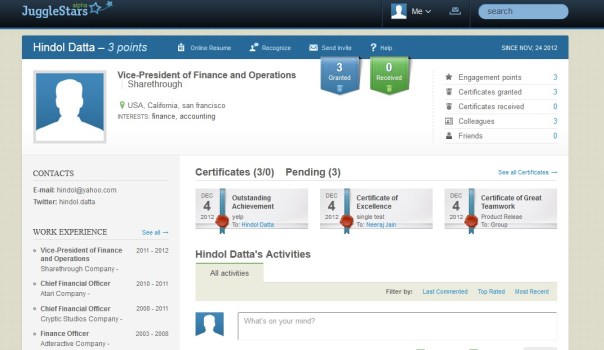
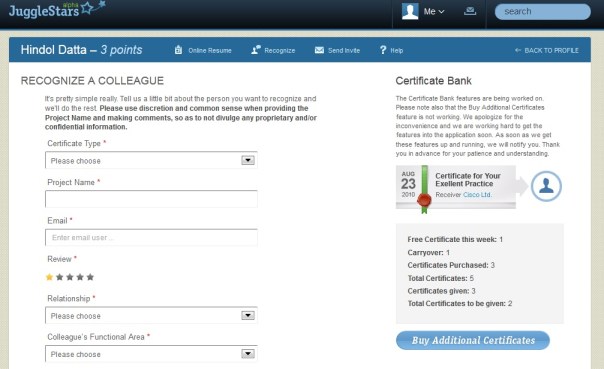
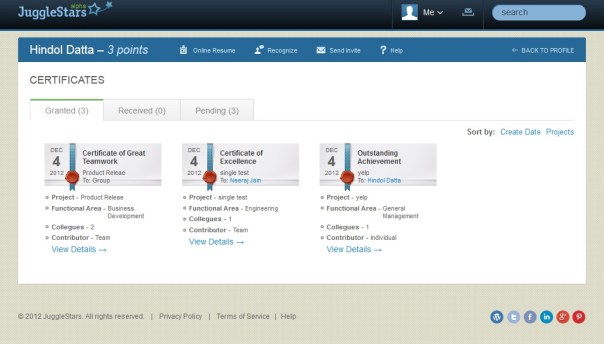
Please support Jugglestars. This is an Alpha Release. Use the application in your organization. The Jugglestars team will be adding in more features over the next few months. Give them your feedback. They are an awesome team with great ideas. Please click on www.jugglestars.com and you can open an account, go to Account Settings and setup your profile and then you are pretty much ready to go to recognize your team and your colleagues at a project level.

The Unbearable Lightness of Being
Where the mind is without fear and the head is held high
Where knowledge is free
Where the world has not been broken up into fragments
By narrow domestic walls
Where words come out from the depth of truth
Where tireless striving stretches its arms towards perfection
Where the clear stream of reason has not lost its way
Into the dreary desert sand of dead habit
Where the mind is led forward by thee
Into ever-widening thought and action
Into that heaven of freedom, my Father, let my country awake.
– Rabindranath Tagore

Among the many fundamental debates in philosophy, one of the fundamental debates has been around the concept of free will. The debates have stemmed around two arguments associated with free will.
1) Since future actions are governed by the circumstances of the present and the past, human beings future actions are predetermined on account of the learnings from the past. Hence, the actions that happen are not truly a consequent of free will.
2) The counter-argument is that future actions may not necessarily be determined and governed by the legacy of the present and the past, and hence leaves headroom for the individual to exercise free will.

Now one may wonder what determinism or lack of it has anything to do with the current state of things in an organizational context. How is this relevant? Why are the abstract notions of determinism and free will important enough to be considered in the context of organizational evolution? How does the meaning lend itself to structured institutions like business organizations, if you will, whose sole purpose is to create products and services to meet the market demand.
So we will throw a factual wrinkle in this line of thought. We will introduce now an element of chance. How does chance change the entire dialectic? Simply because chance is an unforeseen and random event that may not be pre-determined; in fact, a chance event may not have a causal trigger. And chance or luck could be meaningful enough to untether an organization and its folks to explore alternative paths. It is how the organization and the people are aligned to take advantage of that random nondeterministic future that could make a huge difference to the long term fate of the organization.
The principle of inductive logic states that what is true for n and n+1 would be true for n+2. The inductive logic creates predictability and hence organizations create pathways to exploit the logical extension of inductive logic. It is the most logical apparatus that exists to advance groups in a stable but robust manner to address the multitude of challenges that that they have to grapple with. After all, the market is governed by animal spirits! But let us think through this very carefully. All competition or collaboration that occurs among groups to address the market demands result in homogenous behavior with general homogeneous outcomes. Simply put, products and services become commoditized. Their variance is not unique and distinctive. However, they could be just be distinctive enough to eke out enough profits in the margins before being absorbed into a bigger whole. At that point, identity is effaced over time. Organizations gravitate to a singularity. Unique value propositions wane over time.

So let us circle back to chance. Chance is our hope to create divergence. Chance is the factoid that cancels out the inductive vector of industrial organization. Chance does not exist … it is not a “waiting for Godot” metaphor around the corner. If it always did, it would have been imputed by the determinists in their inductive world and we would end up with a dystopian homogenous future. Chance happens. And sometimes it has a very short half-life. And if the organization and people are aligned and their mindset is adapted toward embracing and exploiting that fleeting factoid of chance, the consequences could be huge. New models would emerge, new divergent paths would be traduced and society and markets would burst into a garden of colorful ideas in virtual oasis of new markets.

So now to tie this all to free will and to the unbearable lightness of being! It is the existence of chance that creates the opportunity to exercise free will on the part of an individual, but it is the organizations responsibility to allow the individual to unharness themselves from organization inertia. Thus, organizations have to perpetuate an environment wherein employees are afforded some headroom to break away. And I don’t mean break away as in people leaving the organization to do their own gigs; I mean breakaway in thought and action within the boundaries of the organization to be open to element of chance and exploit it. Great organizations do not just encourage the lightness of being … unharnessing the talent but rather – the great organizations are the ones that make the lightness of being unbearable. These individuals are left with nothing but an awareness and openness to chance to create incredible values … far more incredible and awe inspiring and momentous than a more serene state of general business as usual affairs.
Reality Distortion Field: A Powerful Motivator in Organizations!
“The reality distortion field was a confounding mélange of a charismatic rhetorical style, an indomitable will, and an eagerness to bend any fact to fit the purpose at hand. If one line of argument failed to persuade, he would deftly switch to another. Sometimes, he would throw you off balance by suddenly adopting your position as his own, without acknowledging that he ever thought differently. “
– Andy Hertzfield on Steve Jobs’ Reality Distortion Field.
Many of us have heard the word – Reality Distortion Field. The term has been attributed to Steve Jobs who was widely known to have communicated messages to his constituency in a manner such that the reality of the situation was supplanted by him packaging the message so that people would take the bait and pursue paths that would, upon closer investigation, be dissonant from reality. But having been an avid acolyte of Jobs, I would imagine that he himself would be disturbed and unsettled by the label. Since when did the promise of a radiant future constitute a Reality Distortion Field? Since when did the ability of a person to embrace what seemingly is impossible and far-fetched and instill confidence in the troops to achieve it constitute a Reality Distortion Field? Since when did the ability of leadership to share in the wonders of unique and disruptive creations constitute a Reality Distortion Field? Since when did dreams of a better future underpinned with executable actions to achieve it constitute a Reality Distortion Field?
The Reality Distortion Field usage reflects the dissonance between what is and what needs to be. It is a slapstick term which suggests that you are envisioning tectonic dissonance rifts between reality and possibilities and that you are leading the awestruck starry-eyed followers off a potential cliff. Some people have renamed RDF as hype of Bulls*#t. They believe that RDF is extremely bad for organizations because it pushes the people outside the comfort zone of physical and logical constraints and is a recipe for disaster. The argument continues that organizations that are grounded upon the construct of reality and to communicate the same are essential to advance the organization. I beg to differ.
So let me address this on two fronts: RDF label and if we truly accept what RDF means … then my position is that it is the single most important attribute that a strong leader ought to embrace in the organization.
The RDF label:
We all know this to be true: A rose by any other name is still a rose. We just happen to call this rose in this context a RDF. It is presumed to be the ability of a person to cast possibilities in a different light … so much so that the impossibilities are reduced to elements just within the grasp of reality. Now I ask you – What is wrong with that? For a leader to be able to cast their vision within the inimitable grasp of an organization is a huge proxy for the faith of the leader of the people in the organization. If a project realistically would take 3 months but a RDF is cast to get a project done in 15 days – that is a tall order – but think of the consequences if people are “seduced” into the RDF and hence acts upon it. It immediately unfolds new pathways of collaboration, unforeseen discoveries into super-efficient and effective methods, it creates trench camaraderie, it distills focus into singularity points to be executed against, it instills and ignites a passion and an engagement around the new stakes in the ground, people become keepers of one another for a consequential and significant conquest, it brings out the creative energies and the limitless possibilities, once the goal is accomplished, of disruptive innovation in means and ends. Of course, one could also counter-argue a plethora of incidental issues in such cases: employees would burn out under the burden of unrealistic goals, employees are set more for failing than succeeding, it would create a disorderly orientation upon groups working together to meet RDF standards, and if one were to fall short …it would be a last straw that may break the camel’s back. So essentially this speaks to the ordinal magnitude of the RDF schema that is being pushed out by leadership.

RDF and the beneficial impact to an organization:
It is the sine qua non of great leadership to be able to push organizations beyond the boundaries of plain convenience. I have, in my career, been fortunate to have been challenged and on many occasions, forced out of my comfort zone. But in having done so successfully on many occasions, it has also given me the confidence to scale mountains. And that confidence is a perquisite that the organization leadership has to provide on a daily basis. After all, one of the biggest assets that an employee in an organization ought to have is pride and sense of accomplishment to their work. RDF unfolds that possibility.
We hear of disruptive innovations. These are defined as innovations that leapfrog the bounds of technology inertia. How does a company enable that? It is certainly not incremental thinking. It is a vision that marginally lies outside our aggregated horizon of sight. The age today which is a result of path breaking ideas and execution have been a result of those visionaries that have aimed beyond the horizons, instilled faith amongst the line men to align and execute, and made the impossible possible. We ought to thank our stars for having leaders that emit an RDF and lead us off our tenebrous existence in our diurnal professional lives.

There is absolutely no doubt that such leadership would create resistance and fierce antipathy among some. But despite some of the ill effects, the vector that drives great innovations lies in the capacity of the organization to embrace degrees of RDF to hasten and make the organizations competitive, distinctive and powerful.


Medici Effect – Encourage Innovation in the Organization
“Creativity is just connecting things. When you ask creative people how they did something, they feel a little guilty because they didn’t really do it, they just saw something. It seemed obvious to them after a while. That’s because they were able to connect experiences they’ve had and synthesize new things. And the reason they were able to do that was that they’ve had more experiences or they have thought more about their experiences than other people.”
– Steve Jobs
What is the Medici Effect?
Frans Johanssen has written a lovely book on the Medici Effect. The term “Medici” relates to the Medici family in Florence that made immense contributions in art, architecture and literature. They were pivotal in catalyzing the Renaissance, and some of the great artists and scientists that we revere today – Donatello, Michelangelo, Leonardo da Vinci, and Galileo were commissioned for their works by the family.

Renaissance was the resurgence of the old Athenian democracy. It merged distinctive areas of humanism, philosophy, sciences, arts and literature into a unified body of knowledge that would advance the cause of human civilization. What the Medici effect speaks to is the outcome that is the result of creating a system that would incorporate what on first glance, may seem distinctive and discrete disciplines, into holistic outcomes and a shared simmering of wisdom that permeated the emergence of new disciplines, thoughts and implementations.
Supporting the organization to harness the power of the Medici Effect
We are past the industrial era, the Progressive era and the Information era. There are no formative lines that truly distinguish one era from another, but our knowledge has progressed along gray lines that have pushed the limits of human knowledge. We are now wallowing in a crucible wherein distinct disciplines have crisscrossed and merged together. The key thesis in the Medici effect is that the intersections of these distinctive disciplines enable the birth of new breakthrough ideas and leapfrog innovation.

So how do we introduce the Medici Effect in organizations?
Some of the key ways to implement the model is really to provide the support infrastructure for
1. Connections: Our brains are naturally wired toward associations. We try to associate a concept with contextual elements around that concept to give the concept more meaning. We learn by connecting concepts and associating them, for the most part, with elements that we are conversant in. However, one can create associations within a narrow parameter, constrained within certain semantic models that we have created. Organizations can hence channelize connections by implementing narrow parameters. On the other hand, connections can be far more free-form. That means that the connector thinks beyond the immediate boundaries of their domain or within certain domains that are “pre-ordained”. In those cases, we create what is commonly known as divergent thinking. In that approach, we cull elements from seemingly different areas but we thread them around some core to generate new approaches, new metaphors, and new models. Ensuring that employees are able to safely reach out to other nodes of possibilities is the primary implementation step to generate the Medici effect.
2. Collaborations: Connecting different streams of thought in different disciplines is a primary and formative step. To advance this further, organization need to be able to provide additional systems wherein people can collaborate among themselves. In fact, the collaboration impact accentuates the final outcome sooner. So enabling connections and collaboration work in sync to create what I would call – the network impact on a marketplace of ideas.
3. Learning Organization: Organizations need to continuously add fuel to the ecosystem. In other words, they need to bring in speakers, encourage and invest in training programs, allow exploration possibilities by developing an internal budget for that purpose and provide some time and degree of freedom for people to mull over ideas. This enables collaboration to be enriched within the context of diverse learning.
4. Encourage Cultural Diversity: Finally, organizations have to invest in cultural diversity. People from different cultures have varied viewpoints and information and view issues from different perspectives and cultures. Given the fact that we are more globalized now, the innate understanding and immersion in cultural experience enhances the Medici effect. It also creates innovation and ground-breaking thoughts within a broader scope of compassion, humanism, social and shared responsibilities.
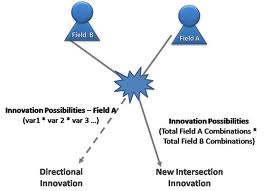
Implementing systems to encourage the Medici effect will enable organizations to break out from legacy behavior and trammel into unguarded territories. The charter toward unknown but exciting possibilities open the gateway for amazing and awesome ideas that engage the employees and enable them to beat a path to the intersection of new ideas.
Transparency in organizations
“We chose steel and extra wide panels of glass, which is almost like crystal. These are honest materials that create the right sense of strength and clarity between old and new, as well as a sense of transparency in the center of the institution that opens the campus up to the street.”

What is Transparency in the context of the organization?
It is the deliberate attempt by management to architect an organization that encourages open access to information, participation, and decision making, which ultimately creates a higher level of trust among the stakeholders.
The demand for transparency is becoming quite common. The users of goods and services are provoking the transparency question:
- Shareholder demand for increased financial accountability in the corporate world,
- Increased media diligence
- Increased regulatory diligence and requirements
- Increased demand by social interest and environmental groups
- Demands to see and check on compliance based on internal and external policies
- Increased employees’ interest in understanding how senior management decisions impact them, the organization and society
There are 2 big categories that organizations must consider and subsequently address while establishing systems in place to promote transparency.
- External Transparency
- Internal Transparency
External Transparency:
Some of the key elements are that organizations have to make the information accessible while also taking into account the risk of divulging too much information, make the information actionable, enable sharing and collaboration, managing risks, and establishing protocols and channels of communication that is open and democratic.
For example, it is important that employees ought to able to trace the integrity, quality, consistency and validity of the information back to the creator. In an open environment, it also unravels the landscape of risks that an organization maybe deliberately taking or may be carrying unknowingly. It bubbles up inappropriate decisions that can be dwelt on collectively by the management and the employees, and thus risks and inappropriateness are considerably mitigated. The other benefit obviously is that it enables too much overlap wherein people spread across the organizations may be doing the same thing in a similar manner. It affords better shared services platform and also encourages knowledge base and domain expertise that employees can tap into.
Internal Transparency:
Organization has to create the structure to encourage people to be transparent. Generally, people come to work with a mask on. What does that mean? Generally, the employees focus on the job at hand but they may be interested to add value in other ways besides their primary responsibility. In fact, they may want to approach their primary responsibility in an ingenious manner that would help the organization. But the mask or the veil that they don separates their personal interest and passions with the obligations that the job demands. Now how cool would it be if the organization sets up a remarkably safe system wherein the distinction between the employees’ personal interest and the primary obligations of the employee materially dissolve? What I bet you would discover would be higher levels of employee engagement. In addressing internal transparency, what the organization would have done is to have successfully mined and surfaced the personal interests of an employee and laid it out among all participants in a manner that would benefit the organization and the employee and their peers.
Thus, it is important to address both – internal and external transparency. However, implementing transparency ethos is not immune to challenges wherein increased transparency may distort intent, slow processes, increase organizational vulnerabilities, create psychological dissonance among employees or groups, create new factions and sometimes even result in poor decisions. Despite the challenges, the aggregate benefit of increased transparency over time would outweigh the costs. At the end, if the organization continues to formalize transparency, it would also simultaneously create and encourage trust and proper norms and mores that would lay the groundwork for an effective workforce.
Reputation is often an organization’s most valuable asset. It is built over time through a focused commitment and response to members’ wants, needs, and expectations. A commitment to transparency will increasingly become a litmus test used to define an association’s reputation and will be used as a value judgment for participation. By gaining a reputation for value through the disclosure of information, extensive communications with stakeholders, and a solid track record of truth and high disclosure of information, associations will win the respect and involvement of current and future members.
Kanter and Fine use a great analogy of transparency like an ocean sponge. These pore bearing organisms let up to twenty thousand times their volume in water pass through them every day. These sponges can withstand open, constant flow without inhibiting it because they are anchored to the ocean floor. Transparent organizations behave like these sponges: anchored to their mission and still allowing people in and out easily. Transparent organizations actually benefit from the constant flow of people and information.
Plans to implement transparency
Businesses are fighting for trust from their intended audiences. Shel Holtz and John Havens, authors of “Tactical Transparency,” state that the realities associated with doing business in today’s “business environment have emerged as the result of recent trends: Declining trust in business as usual and the increased public scrutiny under which companies find themselves thanks to the evolution of social media.” It is important, now more than ever, for organizations to use tools successfully to be sincerely but prudently transparent in ways that matter to their stakeholders.

“Tactical Transparency” adopted the following definition for transparency:
Transparency is the degree to which an organization shares the following with its stakeholder publics:
▪ Its leaders: The leaders of transparent companies are accessible and are straightforward when talking with members of key audiences.
▪ Its employees: Employees or transparent companies are accessible, can reinforce the public view of the company, and able to help people where appropriate.
▪ Its values: Ethical behavior, fair treatment, and other values are on full display in transparent companies.
▪ Its culture: How a company does things is more important today than what it does. The way things are done is not a secret in transparent companies.
▪ The results of its business practices, both good and bad: Successes, failures, problems, and victories all are communicated by transparent companies.
▪ Its business strategy: Of particular importance to the investment community but also of interest to several other audiences, a company’s strategy is a key basis for investment decisions. Misalignment of a company’s strategy and investors’ expectations usually result in disaster.
Here are some great links around transparency.
http://www.socialmediaexplorer.com/social-media-marketing/what-happens-when-transparency-goes-wrong/
According to J.D. Lasica, cofounder of Ourmedia.org and the Social Media Group, there are three levels of transparency that an organization should consider when trying to achieve tactical transparency.
▪ Operational Transparency: That involves creating or following an ethics code, conflict-of-interest policies, and any other guidelines your organization creates.
▪ Transactional Transparency: This type of strategy provides guidelines and boundaries for employees so they can participate in the conversation in and out of the office. Can they have a personal blog that discusses work-related issues?
▪ Lifestyle Transparency: This is personalized information coming from sites like Facebook and Twitter. These channels require constant transparency and authenticity.
Create an Action Plan around policies and circumstances to promote transparency:
Holtz and Havens outline specific situations where tactical transparency can transform a business, some of which are outlined in this list.
▪ Major Crises
▪ Major change initiatives
▪ Product changes
▪ New regulations that will impact business
▪ Financial matters
▪ Media interaction
▪ Employee interaction with the outside world
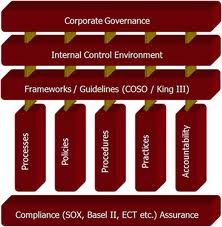
▪ Corporate Governance
▪ Whistleblower programs
▪ Monitoring corporate reputation internally and externally
▪ Whistleblower programs
▪ Accessibility of management
The Big Data Movement: Importance and Relevance today?
We are entering into a new age wherein we are interested in picking up a finer understanding of relationships between businesses and customers, organizations and employees, products and how they are being used, how different aspects of the business and the organizations connect to produce meaningful and actionable relevant information, etc. We are seeing a lot of data, and the old tools to manage, process and gather insights from the data like spreadsheets, SQL databases, etc., are not scalable to current needs. Thus, Big Data is becoming a framework to approach how to process, store and cope with the reams of data that is being collected.

According to IDC, it is imperative that organizations and IT leaders focus on the ever-increasing volume, variety and velocity of information that forms big data.
- Volume. Many factors contribute to the increase in data volume – transaction-based data stored through the years, text data constantly streaming in from social media, increasing amounts of sensor data being collected, etc. In the past, excessive data volume created a storage issue. But with today’s decreasing storage costs, other issues emerge, including how to determine relevance amidst the large volumes of data and how to create value from data that is relevant.
- Variety. Data today comes in all types of formats – from traditional databases to hierarchical data stores created by end users and OLAP systems, to text documents, email, meter-collected data, video, audio, stock ticker data and financial transactions. By some estimates, 80 percent of an organization’s data is not numeric! But it still must be included in analyses and decision making.
- Velocity. According to Gartner, velocity “means both how fast data is being produced and how fast the data must be processed to meet demand.” RFID tags and smart metering are driving an increasing need to deal with torrents of data in near-real time. Reacting quickly enough to deal with velocity is a challenge to most organizations.
SAS has added two additional dimensions:
- Variability. In addition to the increasing velocities and varieties of data, data flows can be highly inconsistent with periodic peaks. Is something big trending in the social media? Daily, seasonal and event-triggered peak data loads can be challenging to manage – especially with social media involved.
- Complexity. When you deal with huge volumes of data, it comes from multiple sources. It is quite an undertaking to link, match, cleanse and transform data across systems. However, it is necessary to connect and correlate relationships, hierarchies and multiple data linkages or your data can quickly spiral out of control. Data governance can help you determine how disparate data relates to common definitions and how to systematically integrate structured and unstructured data assets to produce high-quality information that is useful, appropriate and up-to-date.

So to reiterate, Big Data is a framework stemming from the realization that the data has gathered significant pace and that it’s growth has exceeded the capacity for an organization to handle, store and analyze the data in a manner that offers meaningful insights into the relationships between data points. I am calling this a framework, unlike other materials that call Big Data a consequent of the inability of organizations to handle mass amounts of data. I refer to Big Data as a framework because it sets the parameters around an organizations’ decision as to when and which tools must be deployed to address the data scalability issues.
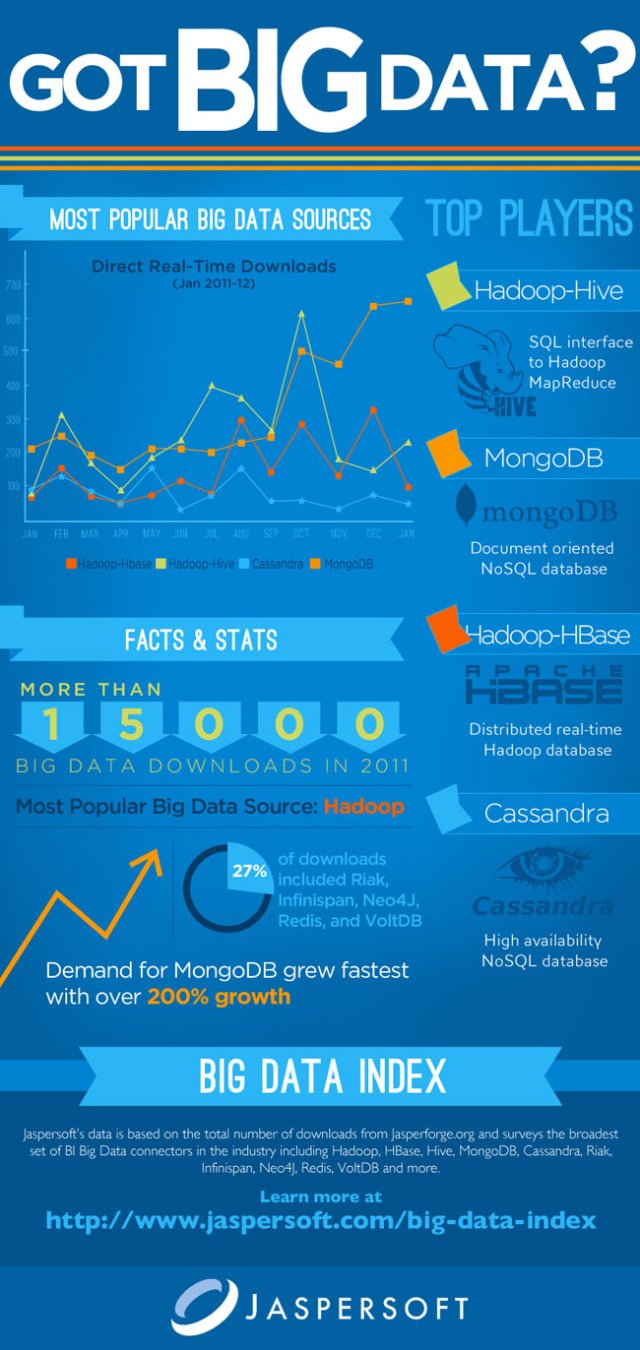
Thus to put the appropriate parameters around when an organization must consider Big Data as part of their analytics roadmap in order to understand the patterns of data better, they have to answer the following ten questions:
- What are the different types of data that should be gathered?
- What are the mechanisms that have to be deployed to gather the relevant data?
- How should the data be processed, transformed and stored?
- How do we ensure that there is no single point of failure in data storage and data loss that may compromise data integrity?
- What are the models that have to be used to analyze the data?
- How are the findings of the data to be distributed to relevant parties?
- How do we assure the security of the data that will be distributed?
- What mechanisms do we create to implement feedback against the data to preserve data integrity?
- How do we morph the big data model into new forms that accounts for new patterns to reflect what is meaningful and actionable?
- How do we create a learning path for the big data model framework?
Some of the existing literature have commingled Big Data framework with analytics. In fact, the literature has gone on to make a rather assertive statement i.e. that Big Data and predictive analytics be looked upon in the same vein. Nothing could be further from the truth!
There are several tools available in the market to do predictive analytics against a set of data that may not qualify for the Big Data framework. While I was the CFO at Atari, we deployed business intelligence tools using Microstrategy, and Microstrategy had predictive modules. In my recent past, we had explored SAS and Minitab tools to do predictive analytics. In fact, even Excel can do multivariate, ANOVA and regressions analysis and best curve fit analysis. These analytical techniques have been part of the analytics arsenal for a long time. Different data sizes may need different tools to instantiate relevant predictive analysis. This is a very important point because companies that do not have Big Data ought to seriously reconsider their strategy of what tools and frameworks to use to gather insights. I have known companies that have gone the Big Data route, although all data points ( excuse my pun), even after incorporating capacity and forecasts, suggest that alternative tools are more cost-effective than implementing Big Data solutions. Big Data is not a one-size fit-all model. It is an expensive implementation. However, for the right data size which in this case would be very large data size, Big Data implementation would be extremely beneficial and cost effective in terms of the total cost of ownership.
Areas where Big Data Framework can be applied!
Some areas lend themselves to the application of the Big Data Framework. I have identified broadly four key areas:
- Marketing and Sales: Consumer behavior, marketing campaigns, sales pipelines, conversions, marketing funnels and drop-offs, distribution channels are all areas where Big Data can be applied to gather deeper insights.
- Human Resources: Employee engagement, employee hiring, employee retention, organization knowledge base, impact of cross-functional training, reviews, compensation plans are elements that Big Data can surface. After all, generally over 60% of company resources are invested in HR.
- Production and Operational Environments: Data growth, different types of data appended as the business learns about the consumer, concurrent usage patterns, traffic, web analytics are prime examples.
- Financial Planning and Business Operational Analytics: Predictive analytics around bottoms-up sales, marketing campaigns ROI, customer acquisitions costs, earned media and paid media, margins by SKU’s and distribution channels, operational expenses, portfolio evaluation, risk analysis, etc., are some of the examples in this category.
Hadoop: A Small Note!
Hadoop is becoming a more widely accepted tool in addressing Big Data Needs. It was invented by Google so they could index the structural and text information that they were collecting and present meaningful and actionable results to the users quickly. It was further developed by Yahoo that tweaked Hadoop for enterprise applications.
Hadoop runs on a large number of machines that don’t share memory or disks. The Hadoop software runs on each of these machines. Thus, if you have for example – over 10 gigabytes of data – you take that data and spread that across different machines. Hadoop tracks where all these data resides! The servers or machines are called nodes, and the common logical categories around which the data is disseminated are called clusters. Thus each server operates on its own little piece of the data, and then once the data is processed, the results are delivered to the main client as a unified whole. The method of reducing the disparate sources of information residing in various nodes and clusters into one unified whole is the process of MapReduce, an important mechanism of Hadoop. You will also hear something called Hive which is nothing but a data warehouse. This could be a structured or unstructured warehouse upon which the Hadoop works upon, processes data, enables redundancy across the clusters and offers a unified solution through the MapReduce function.

Personally, I have always been interested in Business Intelligence. I have always considered BI as a stepping stone, in the new age, to be a handy tool to truly understand a business and develop financial and operational models that are fairly close to the trending insights that the data generates. So my ear is always to the ground as I follow the developments in this area … and though I have not implemented a Big Data solution, I have always been and will continue to be interested in seeing its applications in certain contexts and against the various use cases in organizations.
MECE Framework, Analysis, Synthesis and Organization Architecture toward Problem-Solving
MECE is a thought tool that has been systematically used in McKinsey. It stands for Mutually Exclusive, Comprehensively Exhaustive. We will go into both these components in detail and then relate this to the dynamics of an organization mindset. The presumption in this note is that the organization mindset has been engraved over time or is being driven by the leadership. We are looking at MECE since it represents a tool used by the most blue chip consulting firm in the world. And while doing that, we will , by the end of the article, arrive at the conclusion that this framework alone will not be the panacea to all investigative methodology to assess a problem – rather, this framework has to reconcile with the active knowledge that most things do not fall in the MECE framework, and thus an additional system framework is needed to amplify our understanding for problem solving and leaving room for chance.
So to apply the MECE technique, first you define the problem that you are solving for. Once you are past the definition phase, well – you are now ready to apply the MECE framework.

MECE is a framework used to organize information which is:
- Mutually exclusive: Information should be grouped into categories so that each category is separate and distinct without any overlap; and
- Collectively exhaustive: All of the categories taken together should deal with all possible options without leaving any gaps.
In other words, once you have defined a problem – you figure out the broad categories that relate to the problem and then brainstorm through ALL of the options associated with the categories. So think of it as a mental construct that you move across a horizontal line with different well defined shades representing categories, and each of those partitions of shades have a vertical construct with all of the options that exhaustively explain those shades. Once you have gone through that exercise, which is no mean feat – you will be then looking at an artifact that addresses the problem. And after you have done that, you individually look at every set of options and its relationship to the distinctive category … and hopefully you are well on your path to coming up with relevant solutions.
Now some may argue that my understanding of MECE is very simplistic. In fact, it may very well be. But I can assure you that it captures the essence of very widely used framework in consulting organizations. And this framework has been imported to large organizations and have cascaded down to different scale organizations ever since.
Here is a link that would give you a deeper understanding of the MECE framework:
http://firmsconsulting.com/2010/09/22/a-complete-mckinsey-style-mece-decision-tree/
Now we are going to dig a little deeper. Allow me to digress and take you down a path less travelled. We will circle back to MECE and organizational leadership in a few moments. One of the memorable quotes that have left a lasting impression is by a great Nobel Prize winning physicist, Richard Feynman.
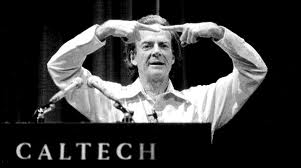
“I have a friend who’s an artist and has sometimes taken a view which I don’t agree with very well. He’ll hold up a flower and say “look how beautiful it is,” and I’ll agree. Then he says “I as an artist can see how beautiful this is but you as a scientist takes this all apart and it becomes a dull thing,” and I think that he’s kind of nutty. First of all, the beauty that he sees is available to other people and to me too, I believe. Although I may not be quite as refined aesthetically as he is … I can appreciate the beauty of a flower. At the same time, I see much more about the flower than he sees. I could imagine the cells in there, the complicated actions inside, which also have a beauty. I mean it’s not just beauty at this dimension, at one centimeter; there’s also beauty at smaller dimensions, the inner structure, also the processes. The fact that the colors in the flower evolved in order to attract insects to pollinate it is interesting; it means that insects can see the color. It adds a question: does this aesthetic sense also exist in the lower forms? Why is it aesthetic? All kinds of interesting questions which the science knowledge only adds to theexcitement, the mystery and the awe of a flower! It only adds. I don’t understand how it subtracts.”

The above quote by Feynman lays the groundwork to understand two different approaches – namely, the artist approaches the observation of the flower from the synthetic standpoint, whereas Feynman approaches it from an analytic standpoint. Both do not offer views that are antithetical to one another: in fact, you need both to gather a holistic view and arrive at a conclusion – the sum is greater than the parts. Feynman does not address the essence of beauty that the artist puts forth; he looks at the beauty of how the components and its mechanics interact well and how it adds to our understanding of the flower. This is very important because the following dialogue with explore another concept to drive this difference between analysis and synthesis home.
There are two possible ways of gaining knowledge. Either we can proceed from the construction of the flower ( the Feynman method) , and then seek to determine the laws of the mutual interaction of its parts as well as its response to external stimuli; or we can begin with what the flower accomplishes and then attempt to account for this. By the first route we infer effects from given causes, whereas by the second route we seek causes of given effects. We can call the first route synthetic, and the second analytic.
We can easily see how the cause effect relationship is translated into a relationship between the analytic and synthetic foundation.
A system’s internal processes — i.e. the interactions between its parts — are regarded as the cause of what the system, as a unit, performs. What the system performs is thus the effect. From these very relationships we can immediately recognize the requirements for the application of the analytic and synthetic methods.
The synthetic approach — i.e. to infer effects on the basis of given causes — is therefore appropriate when the laws and principles governing a system’s internal processes are known, but when we lack a detailed picture of how the system behaves as a whole.

Another example … we do not have a very good understanding of the long-term dynamics of galactic systems, nor even of our own solar system. This is because we cannot observe these objects for the thousands or even millions of years which would be needed in order to map their overall behavior.
However, we do know something about the principles, which govern these dynamics, i.e. gravitational interaction between the stars and planets respectively. We can therefore apply a synthetic procedure in order to simulate the gross dynamics of these objects. In practice, this is done with the use of computer models which calculate the interaction of system parts over long, simulated time periods.

The analytical approach — drawing conclusions about causes on the basis of effects – is appropriate when a system’s overall behavior is known, but when we do not have clear or certain knowledge about the system’s internal processes or the principles governing these. On the other hand, there are a great many systems for which we neither have a clear and certain conception of how they behave as a whole, nor fully understand the principles at work which cause that behavior. Organizational behavior is one such example since it introduces the fickle spirits of the employees that, at an aggregate create a distinct character in the organization.

Leibniz was among the first to define analysis and synthesis as modern methodological concepts:
“Synthesis … is the process in which we begin from principles and [proceed to] build up theorems and problems … while analysis is the process in which we begin with a given conclusion or proposed problem and seek the principles by which we may demonstrate the conclusion or solve the problem.”
So we have wandered down this path of analysis and synthesis and now we will circle back to MECE and the organization. MECE framework is a prime example of the application of analytics in an organization structure. The underlying hypothesis is that the application of the framework will illuminate and add clarity to understanding the problems that we are solving for. But here is the problem: the approach could lead to paralysis by analysis. If one were to apply this framework, one would lose itself in the weeds whereas it is just as important to view the forest. So organizations have to step back and assess at what point we stop the analysis i.e. we have gathered information and at what point we set our roads to discovering a set of principles that will govern the action to solve a set of problems. It is almost always impossible to gather all information to make the best decision – especially where speed, iteration, distinguishing from the herd quickly, stamping a clear brand etc. are becoming the hallmarks of great organizations.

Applying the synthetic principle in addition to “MECE think” leaves room for error and sub-optimal solutions. But it crowd sources the limitless power of imagination and pattern thinking that will allow the organization to make critical breakthroughs in innovative thinking. It is thus important that both the principles are promulgated by the leadership as coexisting principles that drive an organization forward. It ignites employee engagement, and it imputes the stochastic errors that result when employees may not have all the MECE conditions checked off.
In conclusion, it is important that the organization and its leadership set its architecture upon the traditional pillars of analysis and synthesis – MECE and systems thinking. And this architecture serves to be the springboard for the employees that allows for accidental discoveries, flights of imagination, Nietzschean leaps that transform the organization toward the pathway of innovation, while still grounded upon the bedrock of facts and empirical observations.

Implementing Balanced Scorecard Model for Employee Engagement
The Balanced Scorecard Model (BSC) was introduced by Kaplan & Norton in their book “The Balanced Scorecard” (1996). It is one of the more widely used management tools in large organizations.
One of the major strengths of the BSC model is how the key categories in the BSC model links to corporate missions and objectives. The key categories which are referred to as “perspectives” illustrated in the BSC model are:
Financial Perspective:
Kaplan and Norton do not disregard the traditional need for financial data. Timely and accurate data will always be a priority, and managers will do whatever necessary to provide it. In fact, often there is more than enough handling and processing of financial data. With the implementation of a corporate database, it is hoped that more of the processing can be centralized and automated. But the point is that the current emphasis on financials leads to the “unbalanced” situation with regard to other perspectives. There is perhaps a need to include additional financial-related data, such as risk assessment and cost-benefit data, in this category.
Customer Perspective
Recent management philosophy has shown an increasing realization of the importance of customer focus and customer satisfaction in any business. These are leading indicators: if customers are not satisfied, they will eventually find other suppliers that will meet their needs. Poor performance from this perspective is thus a leading indicator of future decline, even though the current financial picture may look good. In developing metrics for satisfaction, customers should be analyzed in terms of kinds of customers and the kinds of processes for which we are providing a product or service to those customer groups
Internal Business Process Perspective
This perspective refers to internal business processes. Metrics based on this perspective allow the managers to know how well their business is running, and whether its products and services conform to customer requirements (the mission). These metrics have to be carefully designed by those who know these processes most intimately; with our unique missions these are not necessarily something that can be developed by outside consultants. My personal opinion on this matter is that the internal business process perspective is too important and that internal owners or/and teams take ownership of understanding the process.
Learning and Growth Perspective
This perspective includes employee training and corporate cultural attitudes related to both individual and corporate self-improvement. In a knowledge-worker organization, people — the only repository of knowledge — are the main resource. In the current climate of rapid technological change, it is becoming necessary for knowledge workers to be in a continuous learning mode. Metrics can be put into place to guide managers in focusing training funds where they can help the most. In any case, learning and growth constitute the essential foundation for success of any knowledge-worker organization.
Kaplan and Norton emphasize that ‘learning’ is more than ‘training’; it also includes things like mentors and tutors within the organization, as well as that ease of communication among workers, the engagement of the workers, the potential of cross-training that would create pockets of bench strength and switch hitters, and other employee specific programs that allows them to readily get help on a problem when it is needed. It also includes technological tools; what the Baldrige criteria call “high performance work systems.”
Innovation Perspective
This perspective was appended to the above four by Bain and Company. It refers to the vitality of the organization and its culture to provide the appropriate framework to encourage innovation. Organizations have to innovate. Innovation is becoming the key distinctive element in great organizations, and high levels of innovation or innovative thinking are talent magnets.
Taking the perspectives a step further, Kaplan and Cooper instituted measures and targets associated with each of those targets. The measures are geared around what the objective is associated with each of the perspectives rather than a singular granule item. Thus, if the objective is to increase customer retention, an appropriate metric or set of metrics is around how to measure the objective and track success to it than defining a customer.
One of the underlying presumptions in this model is to ensure that the key elements around which objectives are defined are done so at a fairly detailed level and to the extent possible – defined so much so that an item does not have polymorphous connotations. In other words, there is and can be only a single source of truth associated with the key element. That preserves the integrity of the model prior to its application that would lead to the element branching out into a plethora of objectives associated with the element.
Objectives, Measures, Targets and Initiatives
Within each of the Balance Scorecard financial, customer, internal process, learning perspectives and innovation perspectives, the firm must define the following:
Strategic Objectives – what the strategy is to achieve in that perspective
Measures – how progress for that particular objective will be measured
Targets – the target value sought for each measure
Initiatives – what will be done to facilitate the reaching of the target?

As in models and analytics, the information that the model spouts could be rife with a cascade of metrics. Metrics are important but too many metrics associated with the perspectives may diffuse the ultimate end that the perspectives represent.
Hence, one has to exercise restraint and rigor in defining a few key metrics that are most relevant and roll up to corporate objectives. As an example, outlined below are examples of metrics associated with the perspectives:
Financial performance (revenues, earnings, return on capital, cash flow);
Customer value performance (market share, customer satisfaction measures, customer loyalty);
Internal business process performance (productivity rates, quality measures, timeliness);
Employee performance (morale, knowledge, turnover, use of best demonstrated practices);
Innovation performance (percent of revenue from new products, employee suggestions, rate of improvement index);
To construct and implement a Balanced Scorecard, managers should:
- Articulate the business’s vision and strategy;
- Identify the performance categories that best link the business’s vision and strategy to its results (e.g., financial performance, operations, innovation, and employee performance);
- Establish objectives that support the business’s vision and strategy;
- Develop effective measures and meaningful standards, establishing both short-term milestones and long-term targets;
- Ensure company wide acceptance of the measures;
- Create appropriate budgeting, tracking, communication, and reward systems;
- Collect and analyze performance data and compare actual results with desired performance;
- Take action to close unfavorable gaps.
The link above contains a number of templates and examples that you may find helpful.
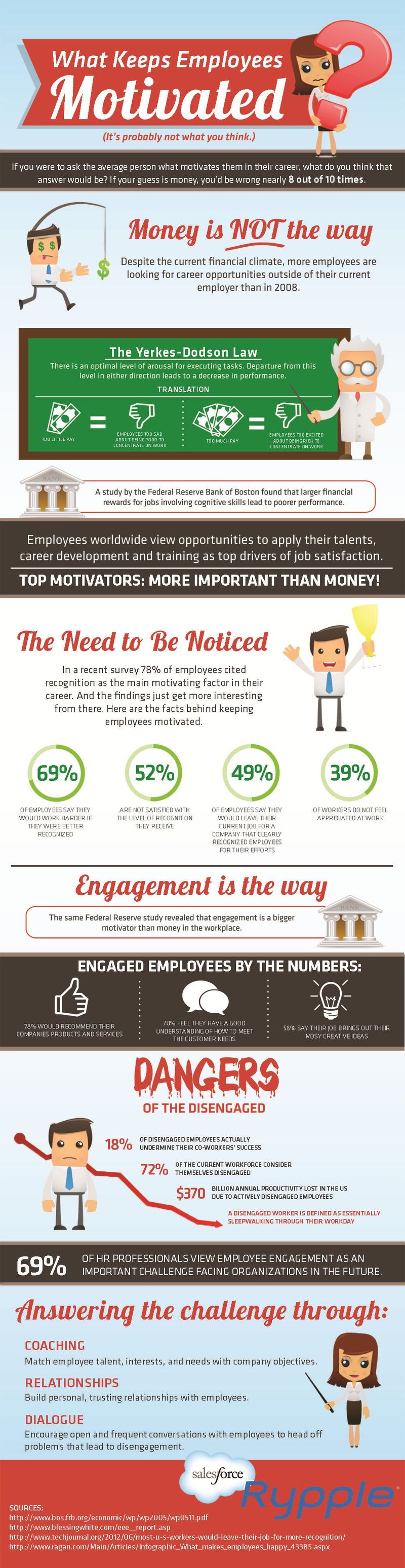
I have discussed organization architecture and employee engagement in our previous blogs. The BSC is a tool to encourage engagement while ensuring a tight architecture to further organizational goals. You may forget that as an employee, you occupy an important place in the ecosystem; the forgetting does not speak to your disenchantment toward the job, neither to your disinclination toward the uber-goals of the organization. The forgetting really speaks to potentially a lack of credible leadership that has not taken the appropriate efforts to engage the organization by pushing this structure that forces transparency. The BSC is one such articulate model that could be used, even at its crudest form factor, to get employees informed and engaged.

 Linked Stars Blog